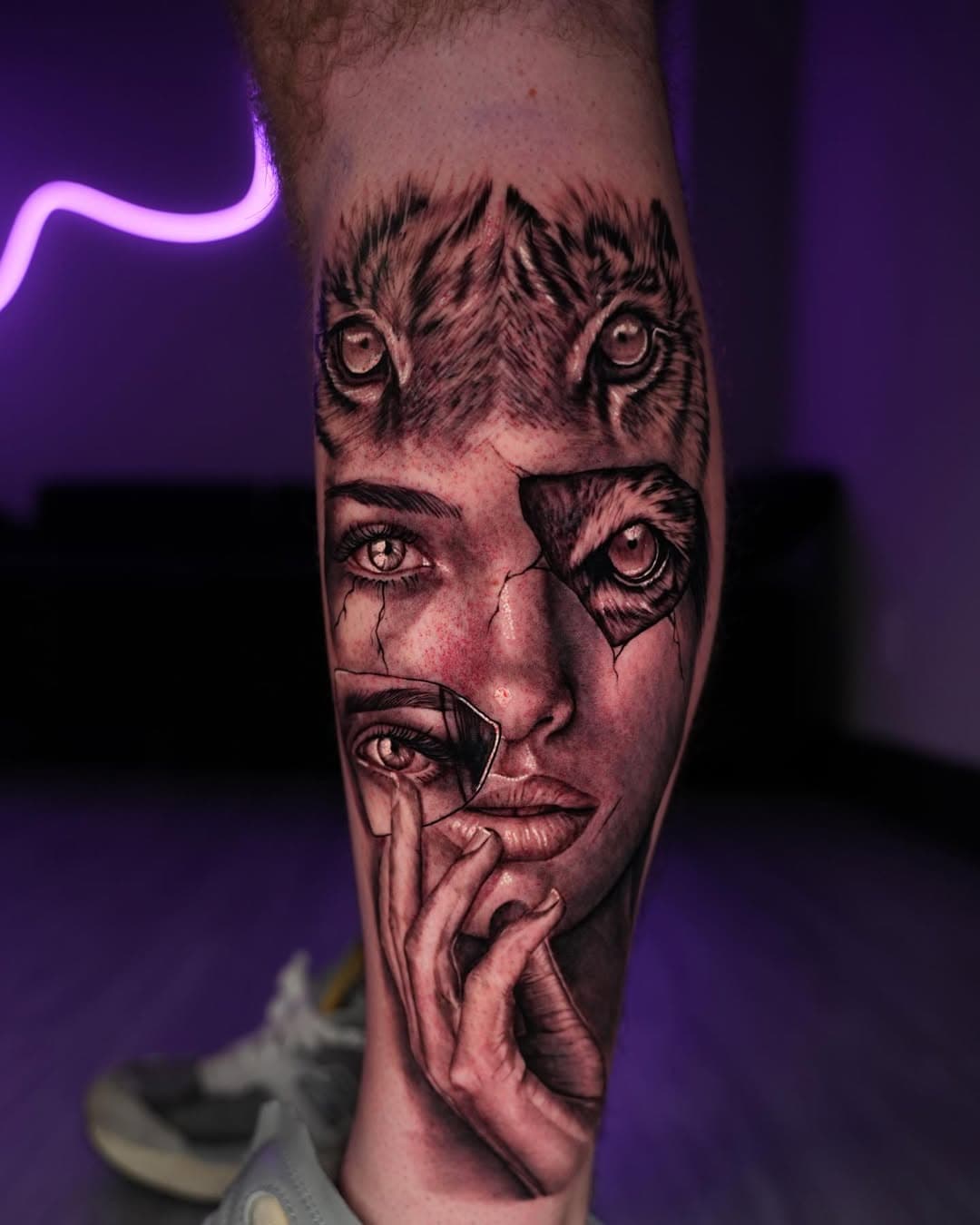
High Contrast Black and Grey: Why These Tattoos Read From Across the Room
What high contrast black and grey actually is, why it keeps its shape as it ages, which subjects suit it, and who at Ink Theory does it.
In this post
Most people can spot a high contrast black and grey tattoo before they can name the style. You see it from across a room and you already know what it is. A lion. A statue. A face. That instant read is the whole point, and it comes down to one decision the artist makes before the needle touches skin: how far to push the darks, and how much skin to leave alone.
What black and grey actually is
Black and grey is tattooing with one ink family. The artist works with black, a range of greys made by thinning that black down, and sometimes a touch of white for the brightest highlights. The lightest tone in the piece is usually not ink at all. It is your skin.
That last part matters more than anything else in this post. In black and grey, open skin is a color. A good artist plans where it goes the same way a painter plans where the light hits.
So what makes it high contrast?
Every black and grey tattoo sits somewhere on a scale. At one end is soft, smoky work where most of the piece lives in the middle greys. At the other end is high contrast: deep, solid blacks placed right next to open skin, with the greys doing the job of connecting the two.
Think of a marble statue under a single spotlight. One side is lit up bright. The other side falls off into shadow. Your eye reads the form right away because the light and the dark are far apart. High contrast black and grey builds a tattoo the same way.
In black and grey, open skin is a color. The brightest part of the tattoo is the part nobody tattooed.
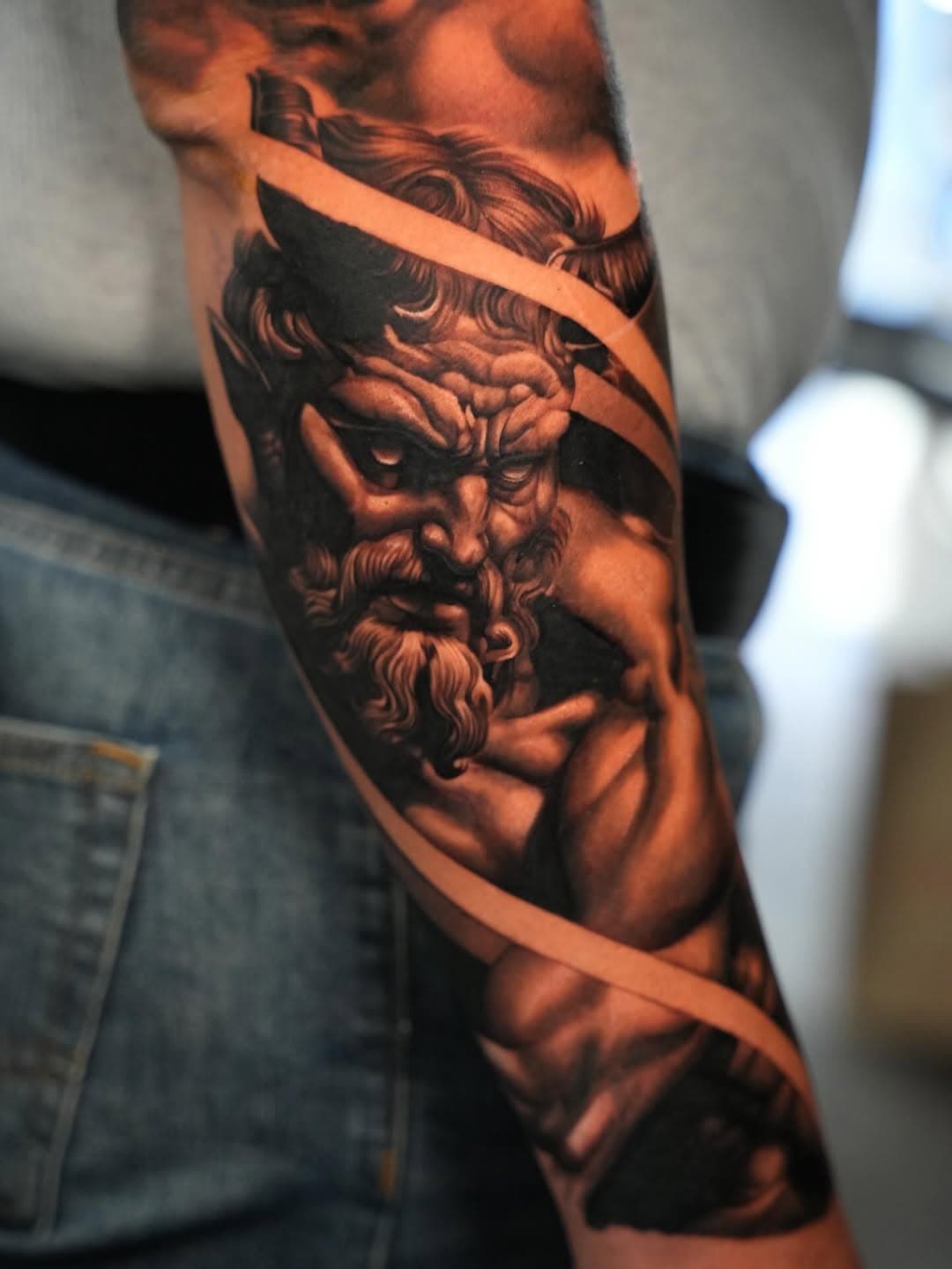
Look at the forearm piece at the top of this post, from the Ink Theory portfolio. The space behind the head, the eye sockets, and the shadow under the arm are packed in dark. The forehead, the curls of the beard, and the shoulder catch the light. Then there is the ribbon of bare skin that wraps across the whole design. Nothing was tattooed there. It is the brightest thing in the piece, and it makes everything around it look deeper.
Why it holds up over the years
Every tattoo softens as it ages. Ink settles, edges spread a little, and the finest details are the first thing to blur. That happens to all of them, no matter who did the work.
What changes is how much the design depends on those fine details to make sense. A piece built on small shifts between similar greys has less to fall back on when it softens. A piece built on strong darks and open skin still has its structure. The big shapes of light and shadow are what your eye reads first, and they are the last thing to go.
Two things are on you after that. Follow your aftercare while it heals, and once it is healed, keep it out of heavy sun or under sunscreen. Sun is the biggest thing that fades a tattoo over time. Our aftercare steps are in the FAQ.
Subjects that suit the style
High contrast works best when the subject already has strong light in it. That is why you see so much of this:
- Statues and Greek mythology. Carved stone is nothing but light and shadow, so it translates almost directly.
- Religious pieces. Halos, rays, and candlelight give the artist a light source to work from.
- Portraits. A face lit from one side has depth. A face lit flat from the front does not.
- Animals. Lions, tigers, and horses have texture and muscle that catch light well.
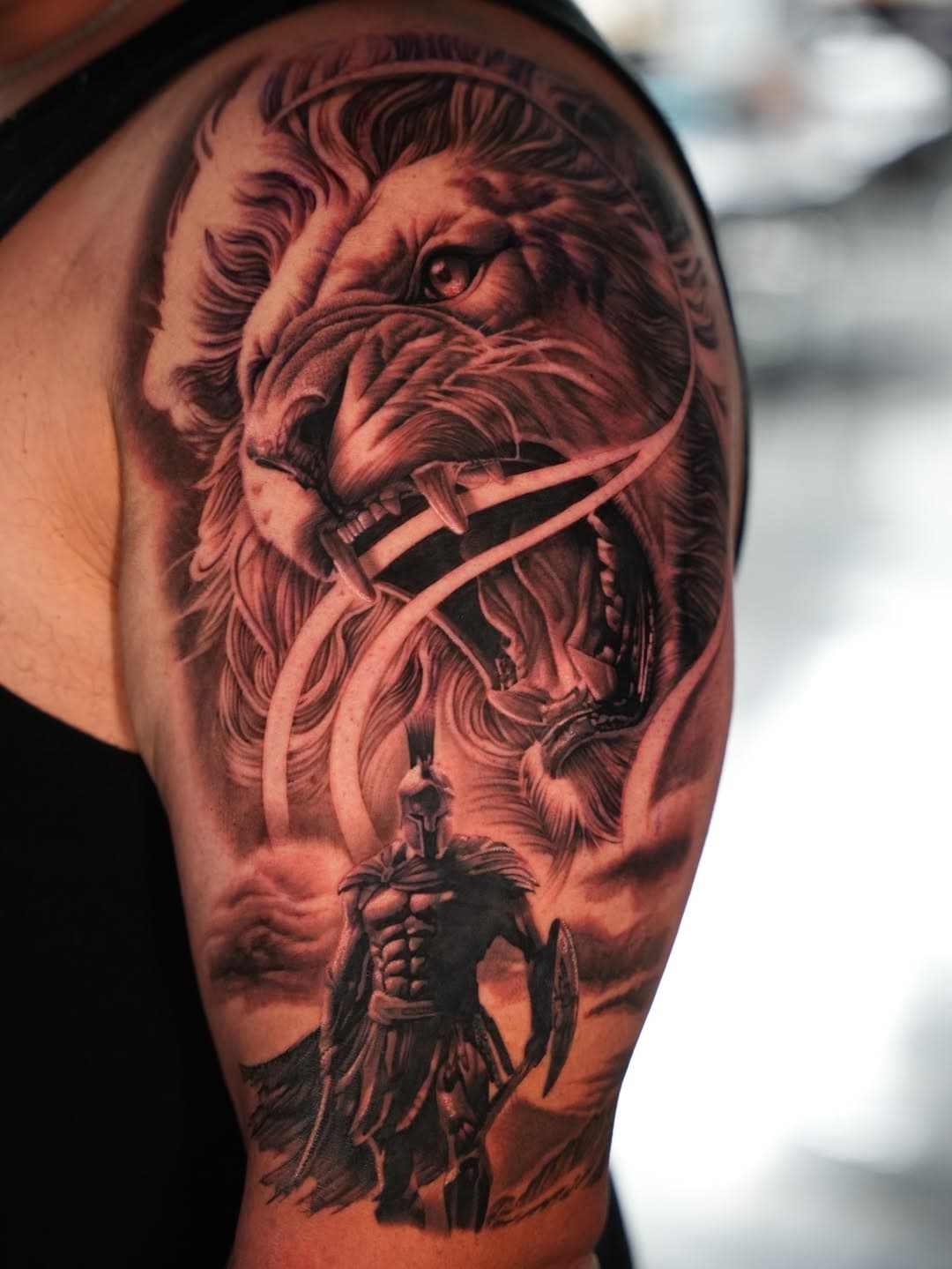
This is the lane Steven is known for: photo realism, high contrast black and grey, religious and Greek mythology work, portraits, and large scale arm and leg pieces. You can see more of it in the gallery.
It needs room
Realism needs space. The more detail there is in your reference, the more skin the piece needs to hold it. That is why this style shows up most on forearms, upper arms, legs, chests, and backs.
For planning, here is how long each size usually takes at our studio:
| Size | What that means | Time in the chair |
|---|---|---|
| Tiny | 0 to 3 inches | 1 to 2 hours |
| Palm Size | 4 to 7 inches | 4 to 6 hours |
| Quarter Sleeve | Upper or lower arm section | 6 to 8 hours |
| Half Sleeve | Upper, lower, or outer arm | About 2 days |
| Full Sleeve | Full arm coverage | 3 to 4 days (8 hrs/day) |
Small realism is its own discipline. If you want something tiny with a lot of detail packed in, that is micro realism, and Eliza and Alyssa are the two on our team who do it.
Who does what at Ink Theory
- High contrast black and grey. Steven and Darius
- Realism. Steven and Alyssa
- Portraits. Steven
- Fine line. Darius and Eliza
- Micro realism. Eliza and Alyssa
- Color. Alyssa
Every artist on the team works in black and grey. If you are not sure whose lane your idea falls in, you do not have to figure that out. Tell us the idea and we match you. Meet the artists.
How to brief a high contrast piece
- Bring references with strong lighting. One clear light source beats a flat, evenly lit photo.
- Pick the placement first. The shape of the body part decides the shape of the design.
- Send a photo of the area. Our questionnaire asks for one so the artist can see the space they are working with.
- Say what has to be in it, then let the artist compose. You bring the subject. They decide where the light goes.
Quick answers
What is the difference between black and grey and high contrast black and grey?
Both use black ink, diluted greys, and open skin. High contrast pushes the two ends further apart: solid blacks placed right next to open skin, with fewer soft middle greys. The result reads clearly from a distance.
Does a high contrast black and grey tattoo have to be big?
No, but realism needs room. The more detail in your reference, the more skin it needs. Tiny, detailed pieces are micro realism, which Eliza and Alyssa do at our studio.
Who does high contrast black and grey at Ink Theory?
Steven and Darius. Every artist on the Lewisville team works in black and grey.
How long does a black and grey sleeve take?
At our studio a half sleeve takes about 2 days and a full sleeve takes 3 to 4 days, working full days.